

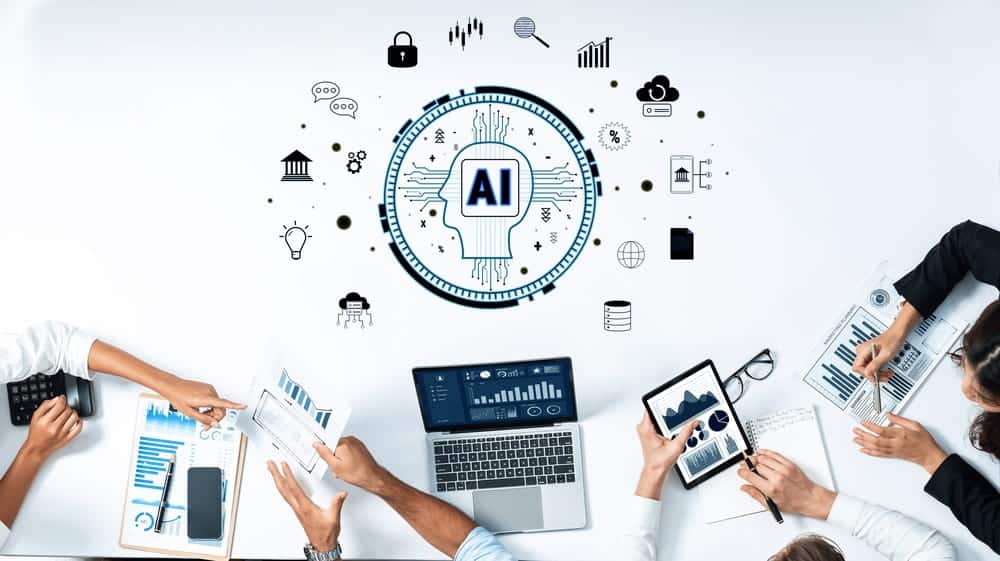
AI helps employees work faster by automating routine tasks, generating content, and analyzing information. As AI adoption grows, business leaders must also understand the cybersecurity, compliance, and data privacy risks associated with entering company information into AI platforms. Organizations that establish clear policies and leverage managed cybersecurity services before deploying AI tools are better positioned to adopt AI responsibly while protecting sensitive business data.
What Is AI and Why Are Businesses Using It?
Artificial intelligence (AI) refers to computer systems capable of performing tasks that typically require human intelligence, such as analyzing information, recognizing patterns, generating content, and making recommendations. Recent advances in generative AI have made these capabilities accessible to organizations of all sizes through tools such as ChatGPT, Microsoft Copilot, Google Gemini, and industry-specific AI platforms.
Businesses are adopting AI to improve efficiency across departments, allowing employees to spend less time on repetitive tasks and focus on higher-value work that requires critical thinking and decision-making.
The growing accessibility of AI presents significant opportunities for businesses, but it also introduces new cybersecurity and data governance challenges that leaders must address.
Common Ways Employees Are Already Using AI at Work
Employees across countless businesses are already using AI, often before leadership fully understands the extent of its adoption. Many use publicly available AI tools to improve productivity, automate routine tasks, and streamline daily workflows.
Common use cases include drafting emails, reports, presentations, and marketing content, as well as summarizing documents, conducting research, and analyzing data. Sales and customer service teams increasingly rely on AI-powered assistants to streamline communications and answer routine questions.
While these tools can improve efficiency, they can also encourage employees to share sensitive information with external platforms without fully understanding the security, privacy, or compliance implications.
The Cybersecurity Risks Business Managers Need to Understand
AI adoption introduces a new category of cybersecurity risks that business leaders cannot afford to ignore. One of the most common concerns involves employees entering confidential business information into public AI tools. Depending on the platform and settings used, prompts may be stored, analyzed, or incorporated into future model improvements.
Cybercriminals are also using AI to create more convincing phishing emails, automate social engineering campaigns, and identify vulnerabilities more efficiently, increasing both the scale and sophistication of attacks. As AI capabilities continue to advance, organizations must ensure their security controls evolve to keep pace with emerging threats and increasingly sophisticated attack methods.
Another challenge involves shadow AI, which occurs when employees adopt AI tools without approval from IT or management. Unapproved applications may not meet security standards, creating blind spots that expose the organization to unnecessary risk.
How AI Can Expose Sensitive Company Data
One of the most significant risks associated with using AI at work involves data exposure. Employees may upload internal documents, customer information, or proprietary business data into AI platforms to generate summaries, recommendations, or content.
For organizations operating in regulated industries, improper use of AI tools can create compliance violations and increase the risk of exposing sensitive information. Once confidential data leaves the organization’s controlled environment, visibility and control may be reduced, potentially putting intellectual property, customer records, and strategic business information at risk.
A strong data governance strategy will clearly define what information can and cannot be entered into AI systems. Organizations should also maintain a documented cybersecurity incident response plan to help address potential AI-related security incidents.
Why Businesses Need Clear AI Usage Policies
Many organizations have formal policies governing email, internet use, passwords, and mobile devices. AI usage should receive the same level of attention.
An effective AI policy identifies approved tools, defines what data may be entered into AI systems, establishes review requirements for AI-generated content, and provides employee training on responsible use. Business leaders can also involve IT and cybersecurity teams when evaluating new AI platforms to ensure security, privacy, and compliance requirements are met.
Organizations should also establish formal review processes for AI-generated outputs. While AI can improve efficiency, it can also produce inaccurate, misleading, or low-quality content when used without proper oversight. Businesses risk inaccurate decisions and operational inefficiencies when employees rely on AI-generated information without adequate review and oversight.
Create a Safer AI Strategy with Cynergy Tech
AI is rapidly becoming part of everyday business operations, offering significant opportunities to improve productivity and efficiency. However, the benefits of AI should not come at the expense of cybersecurity, compliance, or data privacy.
Cynergy Tech helps organizations navigate emerging technologies while maintaining a strong security posture. If your business is evaluating AI tools, developing governance policies, or strengthening cybersecurity controls, our team can help you build a secure foundation for innovation.
Contact Cynergy Tech today to learn how we can help your organization adopt AI safely and confidently.
Resources:
- https://www.ftc.gov/policy/advocacy-research/tech-at-ftc/2024/01/ai-companies-uphold-your-privacy-confidentiality-commitments
- https://www.ibm.com/think/topics/shadow-ai
- https://www.mbtmag.com/cybersecurity/news/22968985/how-ai-is-changing-security-risks
- https://hbr.org/2026/06/dont-let-ai-slop-muck-up-your-companys-processes